
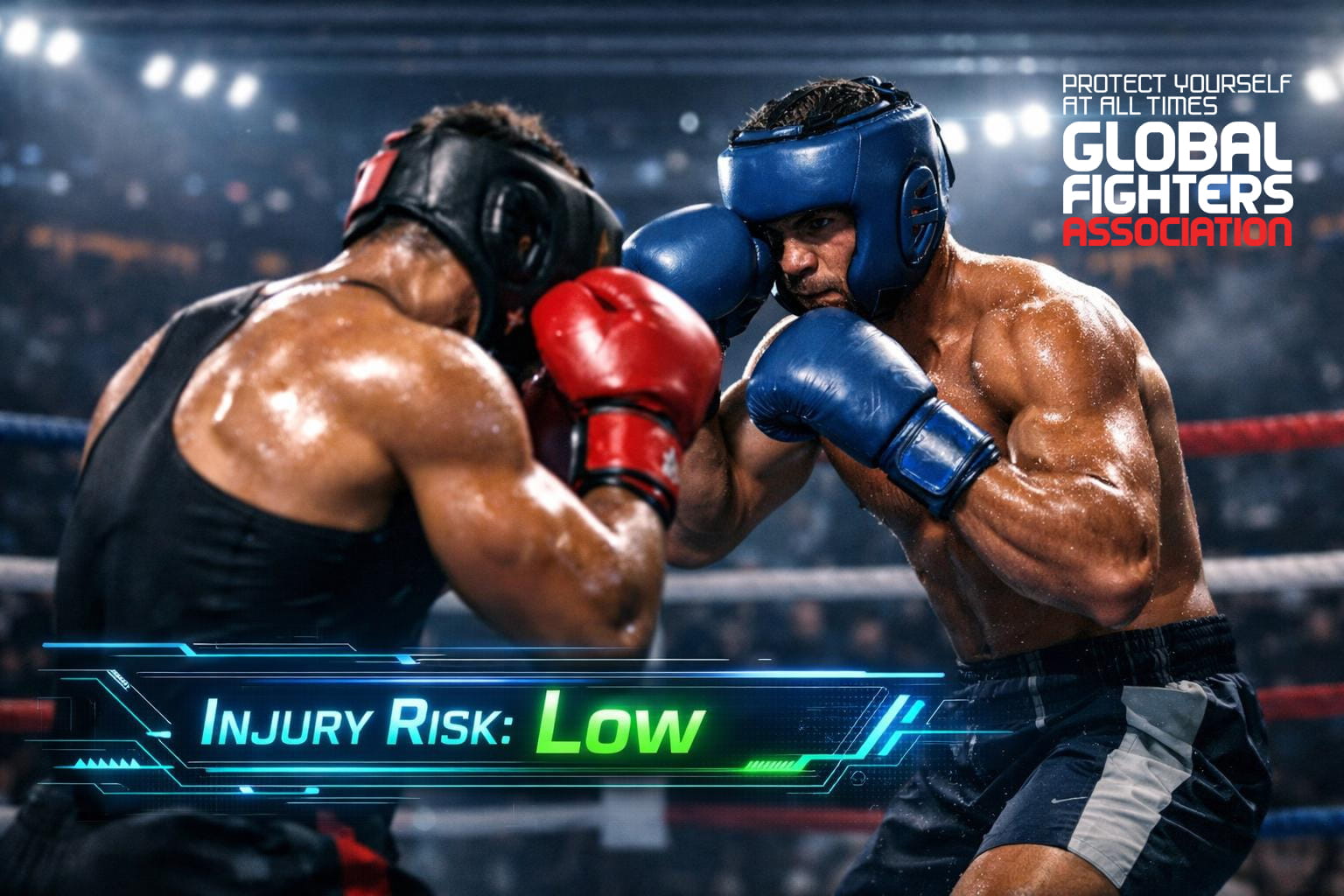
By the Global Fighters’ Association (GFA) Technical Committee
The roar of the crowd, the thud of a landed strike, the chess-match intensity of a high-level grapple; combat sports represent the pinnacle of human physical and mental discipline. However, for too long, the price of this excellence has been measured in the long-term physical toll on the athletes.
At the Global Fighters’ Association (GFA), we believe that the next evolution of combat sports won’t just happen in the gym; it will happen in the data centre. We are standing on the precipice of a technological revolution, where Artificial Intelligence (AI) serves as a “silicon shield” for our athletes.
Disclaimer: A Note on Our Process
Before diving into our vision, it is vital to establish that the following initiatives represent the GFA’s strategic intent, not a definitive or finalised roadmap. Each project mentioned is subject to rigorous feasibility studies, ethical reviews, and technical pilot programs. We are committed to “moving fast,” but in the world of athlete safety, we must prioritise accuracy over speed. These are our goals; our journey to achieve them will be evidence-based and iterative.
I. Moving from Reactive to Proactive: Injury Prediction
Traditionally, sports medicine has been reactive. A fighter gets injured, and we treat the injury. AI allows us to flip the script.
AI-Powered Motion Analysis and Biomechanical Load
Every fighter has a unique “signature” of movement. Over time, fatigue, previous injuries, or improper form can cause subtle shifts in this signature; shifts that are often invisible to even the most seasoned head coaches.
We are exploring the feasibility of a system that uses Computer Vision (CV) to monitor fights/training sessions. By analysing thousands of frames of video, the AI can detect if a fighter’s lead knee is dipping inward during a power shot or if their gait has changed by a few millimeters after a sparring session. These “micro-deviations” are often the precursors to ACL tears or chronic joint issues.
Personalised Risk Assessment Models
No two bodies are the same. A 22-year-old featherweight with a background in wrestling has a vastly different physiological risk profile than a 35-year-old heavyweight striker.
Our proposed Personalised Risk Assessment model aims to integrate:
Historical Data: Past injury reports and recovery times.
Training Load: Real-time data from wearables (heart rate variability, sleep quality, and impact force).
Fight History: Total rounds fought and “damage absorbed” metrics.
The goal is to provide a “Readiness Score.” If the AI flags a high risk of injury, the coach can pivot the day’s training from hard sparring to technical drilling or active recovery.
II. The Digital Ringside: Real-Time Detection
The most critical moments in a fighter’s career often happen in the span of ten seconds following a heavy blow. Human error in these moments can have life-altering consequences.
The Quest for Automated Concussion Detection
Concussions are the “invisible injury.” While referees and ringside physicians are highly trained, they are human. They can be distracted or blinded by a specific angle.
We are investigating AI models capable of analysing live broadcast feeds or high-speed ringside cameras to monitor for “ataxic” movements; the subtle loss of motor coordination that follows a sub-concussive or concussive blow. By flagging these markers instantly to the medical team’s tablets, we can provide an extra layer of “eyes” to ensure no fighter is allowed to take unnecessary punishment.
Remote Assessment and the “Global Doctor”
Not every local promotion has access to a world class neurological specialist. We aim to bridge this gap through a Remote Injury Assessment platform. Using a mobile device, a local trainer could capture video of a fighter’s pupillary response or a specific musculoskeletal test. The AI, trained on thousands of verified injury cases, can provide an immediate probability of severity, helping the onsite team decide whether a trip to the ER is a precaution or a necessity.
III. Optimising the “Human Machine”
Safety and performance are two sides of the same coin. A fighter who is perfectly conditioned is a fighter who is less likely to get hurt.
AI-Driven Training and Recovery
The “old school” mentality of “more is better” is a leading cause of career-ending injuries. We are planning feasibility studies into AI systems that act as a Digital Strength and Conditioning Coach.
By analysing physiological data, the AI can identify when a fighter is entering a state of “overreaching.” Instead of a generic six-week camp, the AI would suggest a dynamic schedule: “Today’s central nervous system fatigue is high; reduce striking volume by 30% and prioritise mobility.” This ensures the fighter reaches the cage at their peak, rather than arriving at the arena already broken.
Technical Form as a Safety Protocol
Incompetent technique is a safety hazard. A punch thrown with a “leaking” wrist or a takedown executed with a rounded spine creates avoidable orthopedic stress. We envision an AI tool where fighters can upload footage of their drills and receive instant feedback on their form, ensuring that their repetitions are building skill without breaking the body.
IV. Democratising Knowledge: Education and Awareness
A safer sport requires a smarter community. AI allows us to scale expert knowledge to every gym on the planet.
The GFA AI Safety Chatbot
Access to sports medicine is expensive. We want to provide every GFA-affiliated athlete with a 24/7 Health and Safety Liaison. This AI chatbot, trained exclusively on peer-reviewed sports science and GFA-vetted medical protocols, can answer questions like:
“What are the signs of a staph infection I should look for?”
“How should I adjust my hydration after a 5lb water weight cut?”
“I have a dull ache in my elbow; what are the best rehab movements?”
Interactive Simulations
We are looking into AI-driven modules for referees and coaches. These simulations would use “generative scenarios” to test a referee’s ability to spot a “flash knockdown” or a coach’s ability to recognise the signs of heat exhaustion in their athlete.
V. The Foundation: Data and Research
To build a safer future, we must first understand the past. The GFA plans to act as a central repository for the largest combat sports injury database in history.
The Injury Surveillance System (ISS)
By anonymising and aggregating injury data from around the world, our AI can identify trends that were previously hidden. Is there a specific type of glove that leads to fewer hand fractures? Does a certain weight-cutting window lead to more kidney issues? The AI will find these patterns, allowing the GFA to advocate for evidence-based rule changes.
VI. The Ethical Guardrails: Privacy, Collaboration, and Access
We recognise that the introduction of AI into a combat environment raises valid concerns. Our feasibility studies will focus heavily on three areas:
Data Sovereignty: A fighter’s medical data is their own. We will implement “Privacy by Design,” ensuring that AI models can learn from data without exposing the identity or specific medical history of the individual athlete.
Scientific Rigour: We are not “tech bros” trying to disrupt for the sake of disruption. Every AI tool will be developed in collaboration with neurologists, orthopedic surgeons, and elite coaches to ensure the “advice” given by a machine aligns with medical best practices.
The Accessibility Gap: High-tech safety shouldn’t be a luxury for the top 1%. Our goal is to develop tools that work on a standard smartphone, making the benefits of AI available to a prospect in a small gym in São Paulo just as much as a champion in Las Vegas.
Conclusion: The Path Forward
The Global Fighters’ Association is committed to the long game. The projects outlined here are ambitious, and we expect challenges. Some may prove more feasible than others, and some may take years to reach the field.
However, the cost of doing nothing is far higher. We owe it to the men and women and children who step into the ring to use every tool at our disposal to protect them. This is not a definitive roadmap; it is a promise to explore every possible avenue that technology offers to make combat sports safer, more sustainable, and more professional.
The fight for athlete safety has a new ally. And it’s powered by intelligence.
FAQ’s
As we launch our feasibility studies, we will be looking for GFA Beta Testers. If you are a gym owner, coach, or active fighter interested in being at the forefront of sports technology, keep an eye on our blog/newsletter for upcoming pilot program applications.
We aren’t trying to change the heart of combat sports. We know that fighters pride themselves on their resilience. However, there is a difference between “toughness” and “unnecessary risk.” AI helps us remove the risks that don’t need to be there (like training through a stress fracture or returning too early from a concussion) so that you can stay in the sport you love for longer.
Our goal is the exact opposite. While elite athletes often have a team of specialists, amateur and regional fighters often have the least medical support. We are prioritising “low-hardware” solutions; such as apps that use a standard smartphone camera for motion analysis, to ensure that a prospect in a local gym has access to the same safety standards as a world champion.
AI is only as good as the data it’s trained on. Combat sports involve chaotic, high-speed movements that are harder to track than a golf swing or a sprint. This is why we are partnering with specialists like Jabbr.ai and Tolion Health to ensure our models understand the specific nuances of MMA, Boxing, and Muay Thai. We will not “greenlight” any tool until it meets a rigorous gold standard of scientific accuracy.
This is a valid concern. If an AI flags a “high injury risk,” could a promoter offer a lower purse? To prevent this, the GFA is exploring strict “Data Use Policies.” We believe safety data should be used for protection and preparation, not for commercial leverage. Part of our feasibility studies will involve working with legal experts to create guardrails that prevent data-based discrimination.
No. AI is a tool, not a replacement. Think of it as a “digital second opinion.” A referee’s intuition and a doctor’s years of clinical experience are irreplaceable. The AI is there to provide them with data points they might not be able to see, like the exact force of a blow or a subtle change in a fighter’s gait; allowing them to make the most informed decisions possible.
At the GFA, we believe in Athlete Data Sovereignty. Your biomechanical, medical, and performance data belong to you. Our proposed framework ensures that while the AI learns from aggregated, anonymised data to improve safety for everyone, your individual profile cannot be shared or sold without your explicit, informed consent.
A feasibility study is a dedicated research phase where we test a concept on a small scale before a full rollout. For example, before deploying “Real-time Concussion Detection” globally, we will run a pilot program in a controlled gym environment to see if the sensors are accurate and if the data is actually helpful to doctors. We are doing this to ensure that we never deploy technology that is unreliable or intrusive.


